Songwriter website guide for 2026: how to show your catalog, credits and demos
A songwriter website is a place to hear your songs, see what you wrote and find out how to contact you.
Put a selection of demos near the top, give each song clear credits, and make the rest of your catalog
easy to browse. Choose a builder around how you want to share the music.
Heya is made by the team that wrote this guide, so read its row with that in mind. Prices come from each
company's own pages, checked on November 9, 2026.
The short answer
Music and sales Bandzoogle suits songwriters who want audio tracks, a mailing list
and sales tools on their own site.
Template choice Wix suits writers who want a wide choice of templates they can
customize manually or with AI.
Pages and writing WordPress.com suits writers who want room for a catalog, credits
and longer posts.
Compact site Carrd suits writers who want a compact site with links to their songs
and contact details.
Small site with embeds Heya suits writers who want a small site they can edit on a
phone, with music and video brought in through embeds.
Website builders for songwriters
Compare Bandzoogle, Wix, WordPress.com, Carrd and Heya side by side for music features, free options,
domain choices and price.
Builder
Free plan
Paid from
Custom domain
Best for
Bandzoogle
14-day free trial
$9.16/mo billed annually (Lite)
Free .com, .net or .org on website plans
Musicians who sell music, merch and tickets
Wix
$0 Free plan, no credit card
$17/mo (Light), yearly price
Connect one on Premium plans; 1 year free domain voucher on most
Big template library and business tools
WordPress.com
Free plan, no expiry, no credit card
$4/mo billed annually
Paid plans; free first year on annual plans
Blogs and sites that grow with plugins
Carrd
Free Basic plan
$9/year (Pro Lite, 3 sites)
Pro Standard ($19/year) and Pro Plus
One-page sites and landing pages
Heya
Free: 3 sites, 5 pages each, yourname.heya.bio
$3/mo (Pro Lite)
Pro Standard (1) or Pro Plus (up to 10)
Small sites built and edited on a phone
Swipe the table sideways to see every column.
Each option up close
Bandzoogle
Lite $9.16, Standard $14.16, Pro $18.33 a month billed annually
Bandzoogle's Lite plan includes 10 pages, 10 audio tracks of up to 250MB each, and a mailing list
for 100 members; all website plans include hosting, SSL security, SEO tools and a free custom
domain. Lite costs $9.16 per month billed annually or $11.00 per month, and Standard adds a store
for physical products and services at $14.16 per month billed annually or $17.00 per month, with
zero commission fees on sales across its website plans. Prices are in USD, the free trial lasts 14
days, and removing the "Powered by Bandzoogle" footer link requires Pro at $18.33 per month billed
annually or $22.00 per month.
Better at
Musicians who sell music, merch and tickets.
Watch out
Lite holds 10 pages and 10 audio tracks.
Wix
Free; Light $17, Core $29, Business $39 a month (yearly)
Wix has over 2000 templates that you can customize manually or with AI, and its Free plan costs $0
without requiring a credit card. Light, the cheapest paid plan, costs $17 per month and includes 2
GB of storage and 2 site collaborators; Wix displays USD prices for yearly subscriptions paid in
full at purchase. Premium plans let you connect your own domain and remove Wix branding, while the 1
year free domain voucher on most Premium plans applies only to a new domain purchased from Wix.
Better at
Big template library and business tools.
Watch out
Listed prices are for yearly plans paid up front.
WordPress.com
Free; paid from $4 a month billed annually
WordPress.com's free plan has no expiration date and includes 1 GB of storage, unlimited pages and
posts, and basic stats for the last 7 days. A custom domain requires a paid plan: Personal starts at
$2.75 per month when billed every 3 years, while paid plans start at $4 per month when billed
annually. Annual and multi-year paid plans include a custom domain for the first year, and every
paid plan includes access to over 60,000 plugins starting with Personal.
Better at
Blogs and sites that grow with plugins.
Watch out
The free plan has 1 GB of storage and a wordpress.com subdomain.
Carrd
Free; Pro Lite $9, Pro Standard $19, Pro Plus $49 a year
Carrd has a free Basic plan, and Carrd Pro Lite costs $9 a year for 3 sites with Carrd branding
removed, though it doesn't include custom domains or business features such as forms and widgets.
Carrd Pro Standard costs $19 a year for 10 sites and adds custom domains with SSL, forms, and
widgets from Stripe, PayPal, Gumroad and Typeform. Carrd offers a 7-day free Pro trial without
requiring payment details.
Better at
One-page sites and landing pages.
Watch out
Pro Lite does not include custom domains.
Heya
Free; Pro Lite $3, Pro Standard $6, Pro Plus $15 a month
Heya is a no-code builder for one-page and small sites that you can build and edit fully on a phone;
its embed block supports Spotify, SoundCloud, YouTube and Vimeo for songs and videos. Heya Free
costs $0 a month with no time limit or credit card, covers up to 3 sites with up to 5 pages each,
and shows a small "Made with Heya" badge; publishing requires Google sign-in. Heya Pro Standard
costs $6 a month for up to 5 sites with up to 20 pages each, removes the badge and includes 1 custom
domain per account, which you connect using a domain you already own.
Better at
Small sites built and edited on a phone.
Watch out
Free sites show a small "Made with Heya" badge.
Templates to start from
These are Heya templates. Each one is live: open the demo, or start your own from it.
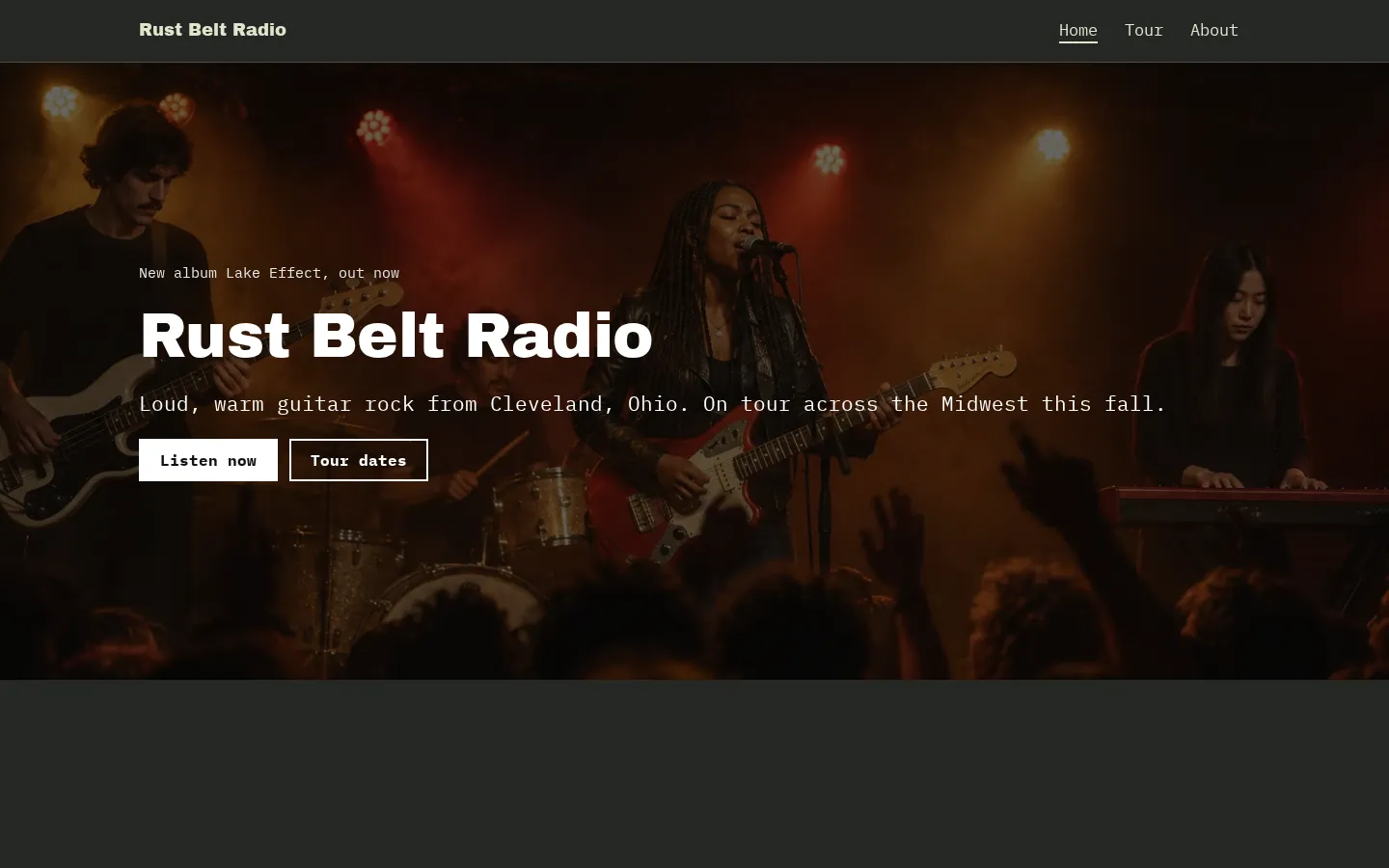
Band websiteA free band website template with your new album, listen links, tour dates, merch, member bios
and booking emails.Open the live demoStart from it
What goes on a songwriter website
Start with your name, what you write and a selection of songs. Give artists, publishers and music
supervisors something to hear without asking them to read your whole biography first, then put your
credits and contact details within easy reach.
Keep the bio short. Say what kind of work you want to be contacted about, and use the name you want
people to credit.
For each featured song, include:
The title.
The writers and your role.
The artist or project, where there is one.
A demo or a link to hear it.
What should get its own page? If your catalog needs more space, separate it from the introduction
rather than squeezing every song into the opening section. Put fuller credits alongside the relevant
work.
And check the contact route before publishing. Use an email address or a form you've tested, and check
that song titles and credits are readable on your phone.
Sharing demos and a catalog
Choose the demos you want someone to hear first, and put them before the larger catalog. Label each
recording as a demo or a released track, and keep the song title and writing credits beside the player
or listening link.
Make the distinction clear.
For a longer catalog, choose labels that describe the songs you have. You could organize it by artist,
project, style or mood, but don't add categories that leave the reader guessing where a song belongs.
Keep the same title wherever you share the same song.
Bandzoogle's Lite plan includes 10 audio tracks, with each file up to 250MB. On Heya, use Spotify or
SoundCloud embeds for songs and YouTube or Vimeo embeds for videos; the media comes through those
services.
Do you want every demo on the public site? Choose what belongs there before adding it. Keep material
you don't intend to publish out of the public catalog, and check that you have permission to share
recordings and name collaborators.
Composer sites and reels
For a composer site, lead with a reel or selected work that matches the projects you want to take on.
Put the project name and your role beside each example, and distinguish your composition credit from
any other work you did on it.
Let the work play.
If you use a reel, give it a clear label and add credits nearby. If you show separate clips, keep each
clip with its project details rather than making visitors match a video to a distant list of titles.
What do you want someone to ask you about? Say that near your contact details. Keep the wording
specific to the work you're offering, without turning it into a long statement about your approach.
For Heya, bring a video reel in through YouTube or Vimeo. Whatever builder you choose, check the
published page on your phone, play the examples, and follow the contact link yourself (not just in the
editor).
Plans change often. If a number here is out of date, email hello@heya.page and we'll fix it.
FAQ
Do songwriters need a website?+
You don't have to make a website before sharing your songs. Use one when you want a place that
brings your demos, credits and contact details together. Start with the work you want heard now,
rather than waiting until you have enough material for a large catalog.
What should a songwriter website include?+
Include your name, a short introduction, selected songs, writing credits and a way to contact you.
Add a fuller catalog if you have more work to show. For each recording, make the song title and
your role clear, and keep the listening link beside that information.
How do I share song demos on my website?+
Use an audio feature your builder provides, an embed from a supported service, or a clearly
labelled listening link. Bandzoogle Lite includes 10 audio tracks, while Heya supports Spotify and
SoundCloud embeds. Put the title and credits next to each demo, then test playback on the
published page.
Can I make a songwriter website for free?+
Yes. Wix, WordPress.com, Carrd and Heya have free plans; Bandzoogle offers a 14-day free trial
before you need an upgrade to keep the site active. Free plans have different limits and domain
options. Start by checking whether the plan can present your chosen songs, credits and contact
details the way you want.